
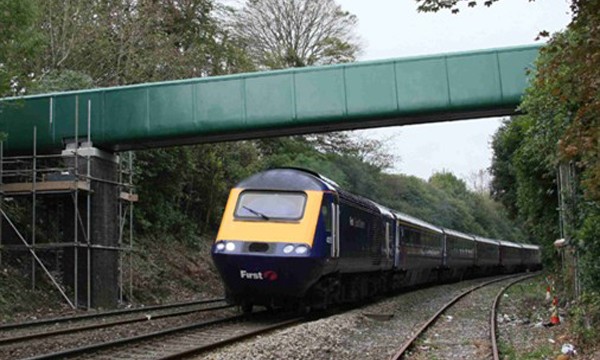
St. Austell Bridge Breaking Boundaries
Parsons Brinckerhoff designed the St. Austell Footbridge, the first of its kind in the U.K.
Pipex, the fabricator, has this amazing PDF detailing the process, here.
From the Parsons Brinckerhoff website:
Network Rail, owner and operator of Britain’s rail system, installed a fiber-reinforced polymer (FRP) footbridge over the railway at St. Austell in Cornwall. FRP is a lightweight, durable, and low-maintenance material. The footbridge is the first structure on the United Kingdom rail network to be constructed entirely of FRP material. The footbridge was easy to install, will not corrode, and will not require painting.
Parsons Brinckerhoff has worked with FRP materials for more than 10 years and has written much of the U.K. standards and guidance on strengthening structures with FRP materials. The firm has specified FRP components to improve the load rating of substandard structures such as concrete bridge decks and columns. However, very few structures are constructed entirely from FRP materials.
The St. Austell Footbridge is one of a number of pilot structures commissioned to test FRP, which could eventually be used more routinely in footbridges, platforms, stairs, and walkways.
Parsons Brinckerhoff pioneered research to validate the structural design, including the development of modes to ensure that the very light bridge would not vibrate when trains passed underneath. Following the installation of the bridge, advanced monitoring confirmed that the design successfully eliminated excessive vibrations.
The River Leri Footbridge is Network Rail’s follow-up to the St. Austell footbridge. The Parsons Brinckerhoff-designed pedestrian bridge near the village of Ynyslas in North Wales is one of the largest FRP structures in the world.
The footbridge, which sits next to an older railway bridge, provides a safe walkway for pedestrians crossing the river and connects existing footpaths on either side. It was built using 11 lightweight prefabricated FRP units, which facilitated construction and allows easy access to the rail bridge for maintenance purposes. The design also used bonded connections instead of bolts in a Parsons Brinckerhoff-developed configuration, also diminishing maintenance requirements.


